
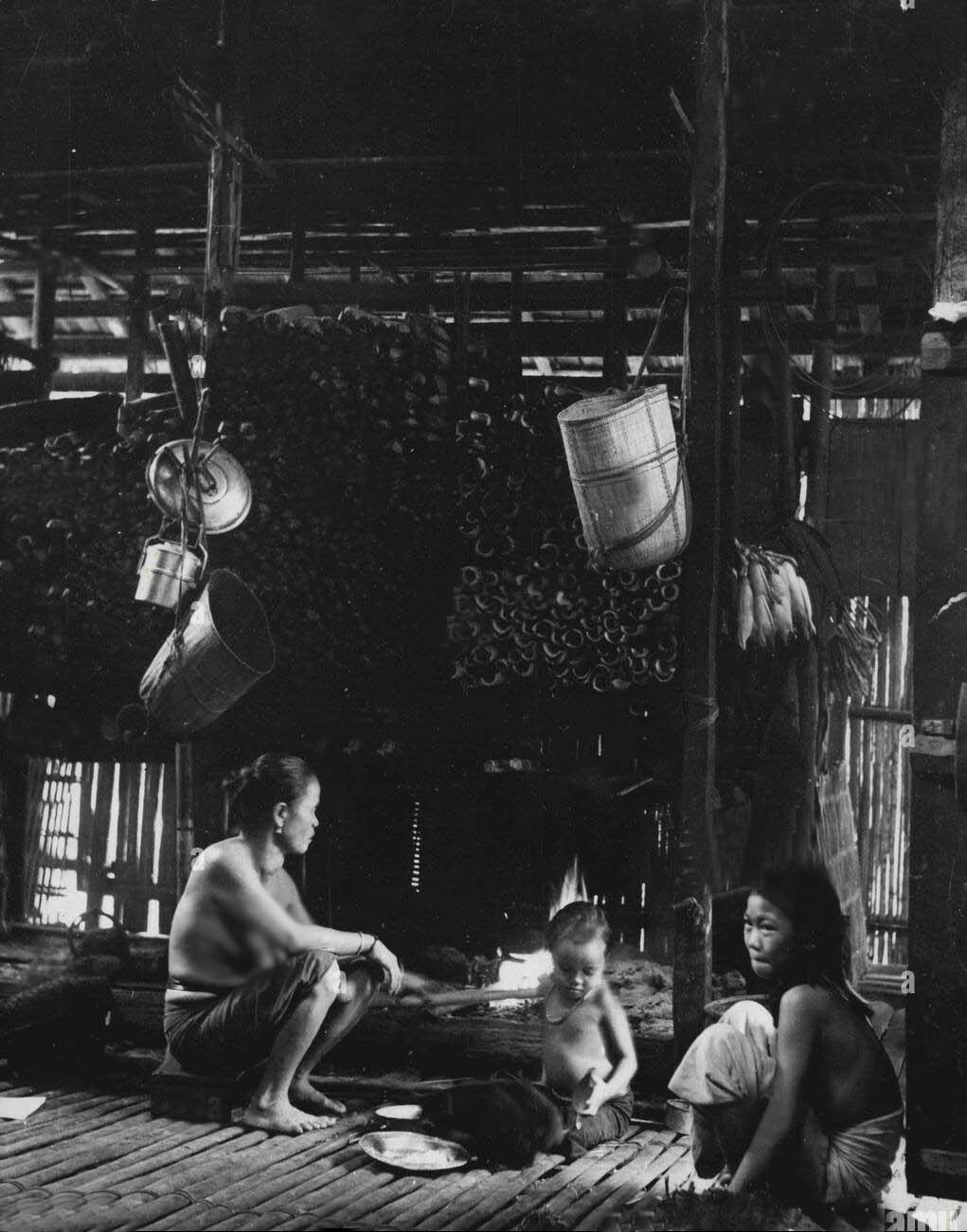
The interior of the household rooms in the longhouse ,above-the fireplace is stacked dry bamboo for firewood and to the side a bundle of- corn is hanging to dry the floor of the room is of bamboo,Phototaken at long house of land Dayak,circa 1930's.


The Dayak Community in Sarawak,celebrated the second Dayak Festival day on Wednesday 1st June 1966.In Kuching,the festival day eve was celebrated at the Sarawak Union Club,it was attended by most community leader of Sarawak including Chief Minister,Datuk Seri Kalong Ningkan.
In an address he said that the Festival marked the ending of a harvest season and signalled the approach of another padi farming season.
The Chief Minister continued"As we celebrate This Gawai Taun,and when we greet each other during this happy day,let us be mindful of the great and continuing need to preserve and strengthen the unity of our country"

Photo taken by Hedda Morrisson circa 1950's

by Hedda Morrison,circa 1950's


This picture taken on April 9, 2017, shows Anyu Daik (R), 70, and Anat Ugom, 44 (L), from a sub-tribe of the Bidayuhs indigenous group, wearing traditional yellow copper rings called "rasung" on their calves, "ruyang" on their forearms and "tumbih" as necklaces as they eat inside their kitchen in Padawan.
There are currently only three Bidayuh women or "ring ladies" still alive there. The women started wearing the yellow copper rings when they were around 10 and have continuously worn them since as they are seen as a sign of beauty and prestige. According to the Bidayuh community, this is a tradition that has been passed down for generations.
It is also believed that their ancestors traded with the Chinese and the copper rings were payment for goods procured from the villagers.
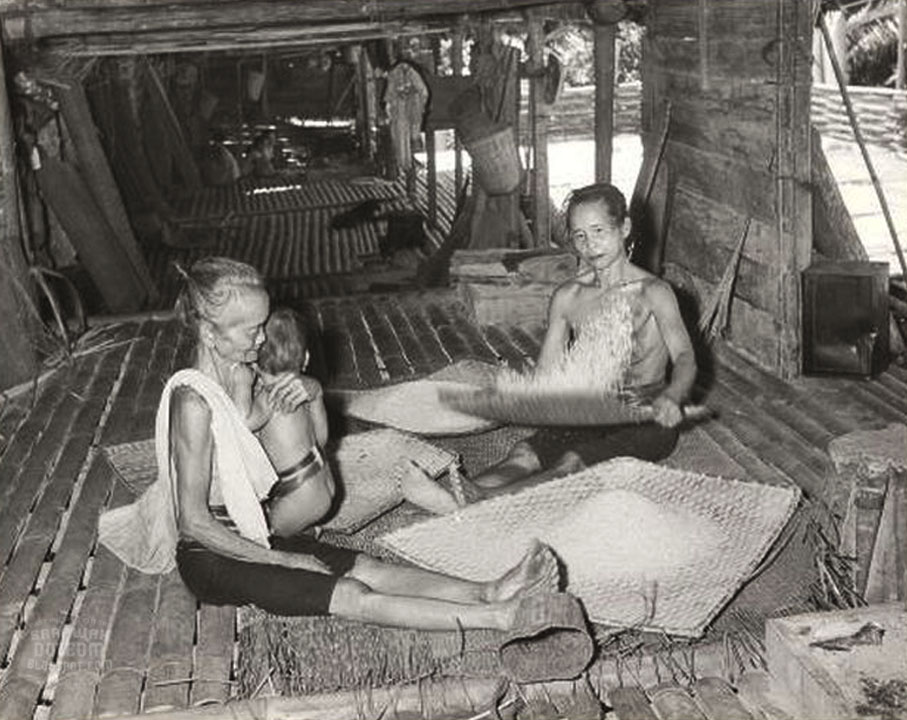
The rice or padi was husked in the longhouse, once harvested, and then winnowed to remove the rice bran.'Women winnowing rice in Land Dayak house' by Hedda Morrison,Circa 1960's.


Traditional Bidayuh Longhouse is open and conducive for a disciplined, communal way of life where honesty, discipline and deligence is automatically imposed on all inhabitants.
Unlike the Ibans, Bidayuh Longhouse actually consists of small longhouses (a few doors) or separate individual homes placed close together and are connected together by platforms of bamboo. Thus they are not that long, straight and level. Ours can be considered split-level, as we have to follow the contour of the land/hills.
Traditional Bidayuh houses are built using timber frames (post and beams), the wall are made of bark or flattened bamboo, the floor is made of section of split bamboo or flattened bamboo and the roofing is of 'attap' (palm-leaf thatch). Another unique thing about Bidayuh architecture, is the complete absent in the use of iron nails. We use a system of joints and the building materials are held in place with the use of special ropes/rattan.
Unfortunately, you can't find anymore Bidayuh Longhouse in Bau District. There might still be one or two in Penrissen, Pedawan or Serian area.
Kpg Giam in the '60s as painted by Ricky Guing Senen.
This is a painting of a Bidayuh Longhouse. Unfortunately you don't get to see these longhouses anymore. Ricky is a programmer dealing with multi-media in a semi-government agency and in recent years is more involved in Communication, Multi- media, DTP and Public Relations activities. One of his hobbies is painting, so I have included this masterpiece of his here on my page. If anyone is interested in his paintings, he can be contacted at:-ssedc@po.jaring.my
Credit to :http://www.cdc.net.my/paular/arch.html


 Bidayuh's Baruk headhouse @ Kg Opar, Sarawak.
In the old days, this is where the Bidayuh keep their enemies skulls.
'Mukah', a Bidayuh religious festival to appease the spirits of 'Tikurouk' (skulls of enemies) is held here. This is no longer practise because most Bidayuhs are now Christians.
Uses of the Baruk.
Another unique thing about Bidayuh architecture, is the complete absent in the use of iron nails. We use a system of joints and the building materials are held in place with the use of special ropes/rattan.
Credit to : http://www.cdc.net.my/paular/arch.html

Bidayuh is the collective name for several indigenous groups found in southern Sarawak, on the island of Borneo, that are broadly similar in language and culture (see also Issues below). The name "Bidayuh" means 'inhabitants of land'. Originally from the western part of Borneo, the collective name Land Dayaks was first used during the period of Rajah James Brooke, the White Rajah of Sarawak. They constitute one of the main indigenous groups in Sarawak and live in towns and villages around Kuching and Samarahan in the Malaysian state of Sarawak. Related groups are also found in the Indonesian province of West Kalimantan. In Sarawak, most of Bidayuh population are found within 40 km of the geographical area known as Greater Kuching, within the Kuching and Samarahan division. They are the second largest Dayak ethnic group in Sarawak after the Iban.

Predominantly Bidayuh areas are: Lundu, Bau, Penrissen, Pad awan, Siburan and Serian. Most of the Bidayuh villages can be found in the rural areas of Lundu, Bau, Padawan, Penrissen and Serian district. The area in which they live is mainly in the basin of the Sarawak River and hilly to mountainous forest, traditionally worked by rotational agriculture and hunting based around farms populated from parent villages situated on the hills for protection. Today, almost all the traditional longhouse-villages have been replaced by individual houses, by roads and there is some plantation agriculture and a reduced emphasis on the growing of hill-padi. Fruit trees, especially durian, remain important property markers. The distinctive architectural and cultural feature of the Bidayuh is the headhouse, now adopted as a symbol.
In Sarawak there are generally said to be three main linguistic groupings (Biatah; Bau-Jagoi; Bukar-Sadong) but these can be broken down even beyond the list referenced below as most people can be distinguished by locals down to village level through smaller differences in vocabulary and intonation. Each area speak its own dialect:
The dialects are not mutually intelligible and English or Malay are often used as common languages.
The Serian Bidayuhs have a distinct dialect known as the Bukar-Sadong Bidayuh, which is not intelligible to Bidayuhs from other Districts. Here are some examples of the differences in the various dialects spoken in Serian, with their English and Malay equivalents. Also included are two Philippine languages, Kapampangan and Tagalog:
| English | Malay | Bukar-Sadong | Bau-Jagoi | Siburan-Padawan | Bra'ang-Pinyawa | Lundu (Salako) | Kapampangan | Tagalog |
|---|---|---|---|---|---|---|---|---|
| Father | Bapa | Amang | Sama | Sama | Sama' | Apak, Bapak | Ibpâ, (Bapa - Uncle) | Amang, Ama |
| Mother | Ibu | Andĕ/ayang | Sino | Sinĕ | Sin(d)o | Inuk, Indok, Umak | Indû | Inang, Ina |
| Food | makanan | pima-an | pinguman | pimaan | Pinguman | Pamakanan | Pamangan | Pagkain |
| Rice | nasi | songkoi/sungkoi | tubi | tubi | Tubi | nasik | nasi | kanin |
| I | aku | aku | oku | Ěku | aku | aku | aku/I-aku | ako |
| You/thee | kamu/anda | amu/akam | mu-u/ingan | ku-u/kaam | (K)u'u/ ka'am | kau | ika (sing.)/ikayu (pl.) | ikaw |
Bidayuhs are traditionally animist, and vestiges of these beliefs still remain. The British colonial times (known as the Brooke family era) saw the arrival of Christian missionaries, bringing education and modern medicine. The great majority of Bidayuh are now Christians, majority of them being Roman Catholic.
Most Bidayuh villages have either a Roman Catholic or Anglican church or a mosque -- rarely more than one or the village would tend to split. The Biatah people, who live in the Kuching area, are Anglican, while the people of the Bau area are Catholic.
The Bidayuh of Bau have a unique tradition of hanging the bodies of the dead on trees and leaving them to rot away. The skeletons are left on trees as a reminder of the dead. The tradition is rarely done nowadays.
Although classified as "Bidayuh" by the Malaysian government, the Salako and Lara culture have little resemblance to other Bidayuh groups and their oral tradition claim different descent and migration histories. Linguistically, the Salako belong to another language family tree which is of the Malayic-Dayak family (the same family as the Iban).[1] The Lara, although said to be more related to the Bidayuh (Jagoi-Singai), speak a language almost not mutually intelligible at all with the Bidayuh but belonged to the same language family tree which is the Land Dayak.[1] Even their customary rituals and rites differ from the other Bidayuhs (all Bidayuhs share almost the same ritual and customary rites).
Link : Wikipedia


